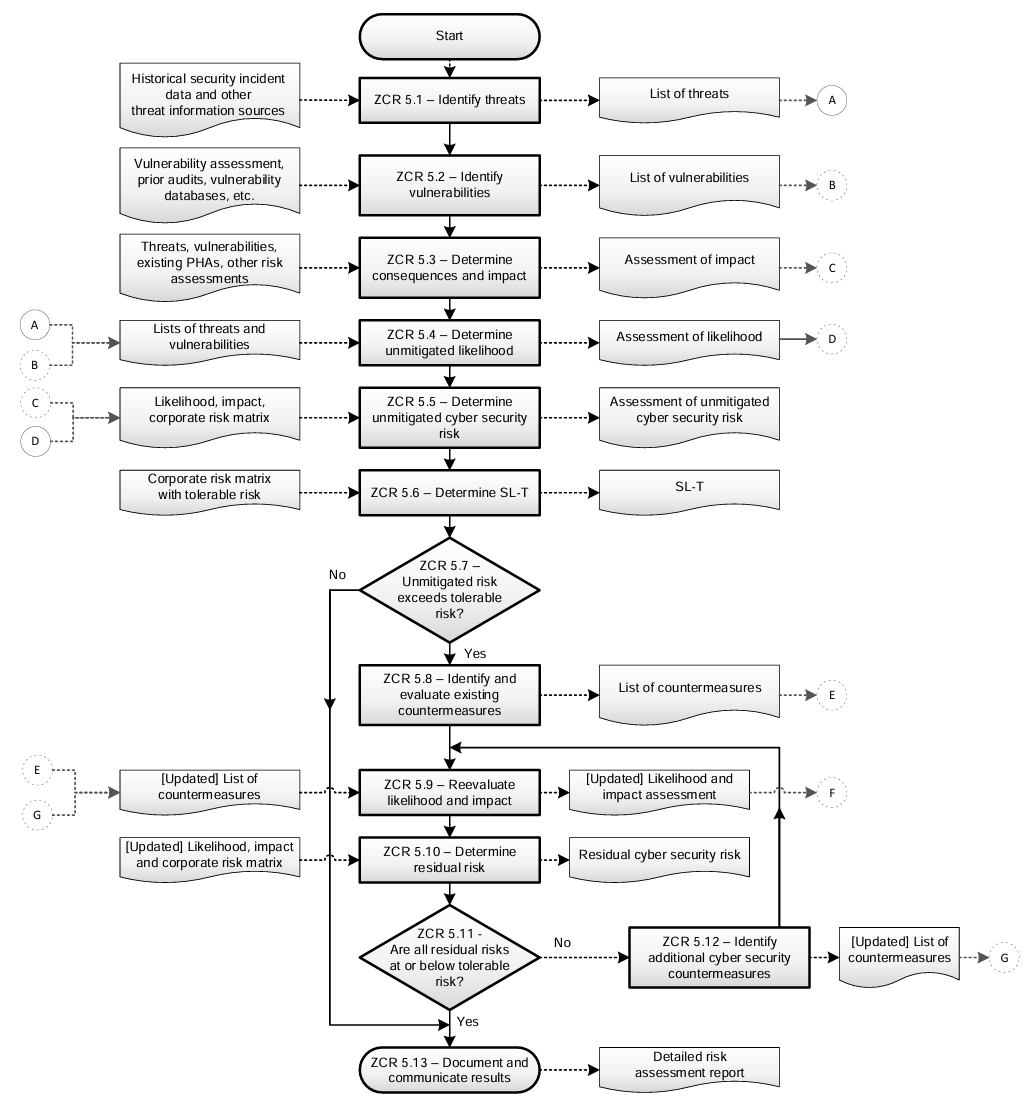
ZCR 5 is applied to every zone and conduit (with permitted grouping where threats,
consequences or assets are similar, or where a standardised reference design is
replicated). It walks each partition from threats and vulnerabilities through unmitigated
risk and SL-T, then through existing and additional countermeasures to
residual risk, ending with protected documentation for stakeholders.
ZCR 5 – Detailed cybersecurity risk assessment
Reference: ISA/IEC 62443-3-2, Clause 4.6
ZCR 5.1: Identify threats
Clause: 4.6.2
Summary
Develop a list of threats that could affect assets inside the zone or conduit. Useful
threat records typically describe the source, capability/skill, possible vectors and
affected assets. Grouping into classes is acceptable when the raw list would be unwieldy.
Expanded teaching material: Threats
(sources, vectors, statements and catalog).
ZCR 5.2: Identify vulnerabilities
Clause: 4.6.3
Summary
Analyse the zone or conduit and record known vulnerabilities of its assets — including
access points. Vulnerability assessments and trusted sources (for example ICS-CERT,
product suppliers) help keep the list realistic.
Expanded teaching material: Vulnerabilities
(including
discovery questions by layer).
(classes, assessment types and tools such as CSET).
ZCR 5.3: Determine consequence and impact
Clause: 4.6.4
Summary
For each threat scenario, evaluate consequence and impact — ideally as worst-case effect
on areas such as personnel safety, finance, business interruption and environment. Draw
on existing PHAs and related risk studies. Low impact may mean moving quickly to the next
threat.
Expanded teaching material: Consequence
(consequence vs impact, categories and ranking).
ZCR 5.4: Determine unmitigated likelihood
Clause: 4.6.5
Summary
Estimate the chance each threat materialises without counting existing
cybersecurity countermeasures (treat those as temporarily removed). Inherent component
behaviour and non-cyber IPLs (physical security, mechanical safeguards, emergency
procedures) may still be recognised. Qualitative or quantitative methods are allowed;
consequence-only methods that treat likelihood as constantly present are also permitted.
Frequency vs probability of success, and the two-pass (unmitigated then mitigated) pattern:
Risk Equation – Frequency vs probability.
ZCR 5.5: Determine unmitigated cybersecurity risk
Clause: 4.6.6
Summary
Combine impact (ZCR 5.3) and unmitigated likelihood (ZCR 5.4) — typically via the
corporate risk matrix — to obtain unmitigated cybersecurity risk for each threat.
How likelihood and consequence combine: Risk Equation.
ZCR 5.6: Determine SL-T
Clause: 4.6.7
Summary
Establish a target security level (SL-T) for each zone or conduit. SL-T may be a single
value or a vector. There is no single mandated calculation: common approaches use the gap
to tolerable risk, the SL definitions in Part 3-3 / Annex A, or iterative risk-matrix
checks that raise SL until residual risk becomes acceptable.
SL-T communicates the desired protection level to designers, implementers and operators.
It later pairs with Part 3-3 capability levels when selecting technical requirements.
Some organisations express the gap between unmitigated cybersecurity risk and tolerable risk
as a cybersecurity risk reduction factor (CRRF) — a measure of how much risk
reduction is required to reach tolerance. CRRF is a teaching aid for sizing SL-T; Part 3-2
does not prescribe a single formula. Practical methods for establishing SL-T include:
- Risk-gap / CRRF — set SL-T from the difference between unmitigated risk and
tolerable risk (higher gap → higher SL-T).
- SL definitions — map each zone or conduit to the qualitative SL 0–4 adversary
definitions in Informative Annex A / ISA-62443-3-3.
- Iterative risk matrix — start from a reasonable SL estimate (including none),
evaluate residual risk with the countermeasures implied by that SL, and raise SL until
risk is acceptable; that final value becomes SL-T.
Record the chosen method with the assessment and carry SL-T into the
CRS.
Further teaching depth:
Part 3-3 Security Levels.
ZCR 5.7: Compare unmitigated risk with tolerable risk
Clause: 4.6.8
Summary
Compare each threat’s unmitigated risk with tolerable risk. If it exceeds tolerance,
decide whether to accept, transfer or mitigate. Mitigation continues through ZCR 5.8–5.12;
otherwise document under ZCR 5.13 and move to the next threat.
ZCR 5.8: Identify and evaluate existing countermeasures
Clause: 4.6.9
Summary
Identify controls already present in the SUC and judge how effectively they reduce
likelihood or impact. Part 3-3 SL-C assignments help reason about technical control
strength.
Most countermeasures aim to reduce likelihood (block threats or shrink the attack surface).
Some also reduce consequence severity — for example Ethernet rate limiting that prevents a
device crash under a network storm but may still leave operators with loss of view. Record
both effects when evaluating controls. Teaching depth:
Mitigated Likelihood and Residual Risk,
Bowtie Diagrams,
SP evidence as countermeasures.
ZCR 5.9: Reevaluate likelihood and impact
Clause: 4.6.10
Summary
Re-score likelihood and impact with those existing countermeasures applied (technical,
administrative and procedural). This produces mitigated values for residual risk.
The mitigated likelihood is often called Mitigated Threat Likelihood (MTL) —
see Mitigated Likelihood and Residual Risk.
ZCR 5.10: Determine residual risk
Clause: 4.6.11
Summary
Combine mitigated likelihood and mitigated impact for each threat to obtain residual risk —
a measure of current exposure and of how well existing controls work.
ZCR 5.11: Compare residual risk with tolerable risk
Clause: 4.6.12
Summary
Compare residual risk against tolerable risk. Where residual risk remains too high,
decide under policy whether to accept, transfer or further mitigate.
ZCR 5.12: Identify additional cybersecurity countermeasures
Clause: 4.6.13
Summary
Unless the organisation chooses to tolerate or transfer remaining risk, identify further
technical, administrative or procedural controls to bring residual risk within tolerance.
Moving an asset into a higher-security zone can also reduce exposure. Part 3-3 is a guide
for selecting technical measures and judging SL-C effectiveness; cost and complexity
should be weighed in design.
ZCR 5.13: Document and communicate results
Clause: 4.6.14
Summary
Document, report and distribute the detailed assessment to appropriate stakeholders,
protecting confidentiality with suitable information-security classification. Record
session dates, participant names and titles, and archive supporting inputs (architecture
diagrams, PHAs, vulnerability and gap assessments, threat sources) with the assessment.
The assessment is a living artefact for testing, audit and later refresh — and a
sensitive one, because it often lists vulnerabilities and current safeguards.
In practice teams produce a Cybersecurity Risk Assessment Report that
provides a risk profile — often presented like a heat map of unmitigated and
mitigated risk by zone (and conduit where assessed). Check Process Hazard Analysis (PHA),
safety, business continuity and disaster recovery units: they may already hold consequence
or criticality artefacts you can leverage. There is no single mandated format; the standards
provide examples.
A good assessment should give designers, for the whole SUC and for each zone and conduit:
- Risk profile — where risk concentrates (unmitigated and mitigated)
- Highest severity consequences — what hurts most if compromise succeeds
- Threats and vulnerabilities leading to the highest risk
(Threats,
Vulnerabilities)
- Target Security Levels (SL-T) — where each partition needs to be
(ZCR 5.6)
- Recommendations from gap analysis — how to get there
Alongside the normative ZCR 5.13 expectations, also record:
- Scope of the assessment
- Dates, locations and participants
- Findings such as high-risk threats, high-risk vulnerabilities and detailed risk-assessment worksheets
- How likelihood and consequences were determined
(Risk Equation,
Consequence)
- Prioritized recommendations from the assessment
Assign appropriate information-security classification and controlled access. The assessment
output (and the
CRS (ZCR 6))
is the primary input to Development & Implementation. Results also feed
asset owner approval (ZCR 7)
and conceptual design work such as
zone and conduit security strategy.
Catalogue context:
Documentation.