Instead of compressing a zone or control system into a single Security Level number,
ISA/IEC 62443 can express a vector of seven values — one Security Level per
Foundational Requirement (FR). Annex A of Part 3-3 discusses this vector approach; risk-assessment
practice in Part 3-2 (Clause A.3.1 themes) uses the same idea when setting targets.
Teaching note: This page paraphrases vector notation and examples for learning.
SL type definitions (SL-T / SL-A / SL-C) and the 0–4 adversary model are covered on
Security Levels. Normative FR requirements are on
the FR pages; packing lists for SL claims are on
Annex B.
Different FRs can legitimately need different strengths in the same zone. A BPCS area may demand
strong restricted data flow and integrity while accepting a lower
confidentiality target if little sensitive data leaves that zone. The vector keeps those
differences visible instead of forcing a single “the zone is SL-3” slogan.
Notation
SL-?(domain) = { IAC , UC , SI , DC , RDF , TRE , RA }
SL-? — type: typically SL-T (target), SL-C (capability) or SL-A (achieved).
domain — zone, conduit, control system, subsystem or component name.
Optional FR tag when quoting only one element, for example SL-C(RA, FS-PLC) = 4.
Teaching examples (values illustrative of the style used in Annex A):
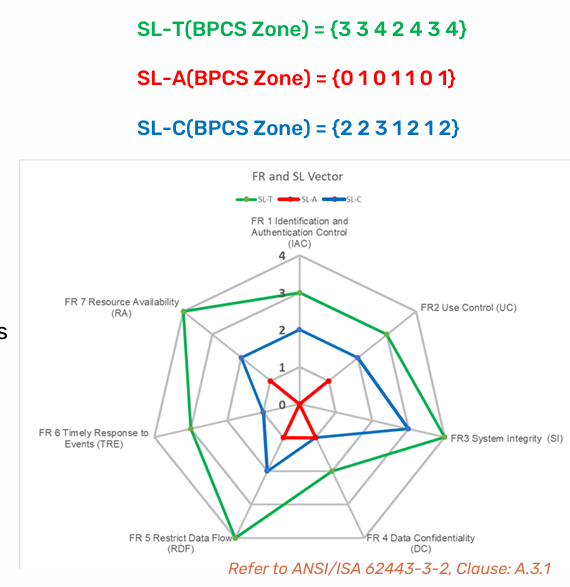
The chart compares three vectors on the same seven FR axes (0 at centre → 4 at the rim):
Figure – Example FR and SL Vector for a BPCS zone. Green = SL-T, blue = SL-C, red = SL-A.
Training materials cite ANSI/ISA 62443-3-2, Clause A.3.1 for this style of example.
Vector
IAC
UC
SI
DC
RDF
TRE
RA
SL-T (target)
3
3
4
2
4
3
4
SL-C (capability)
2
2
3
1
2
1
2
SL-A (achieved)
0
1
0
1
1
0
1
Green is the risk-derived target; blue is what the current design/products can support; red is what
is measured in place. Gaps drive compensating countermeasures, redesign or procurement — not a
claim that the zone as a whole “is SL-3”.
Use with caution
Vector methods draw on quantitative assurance ideas, but cyber risk judgments remain largely qualitative and expert-driven.
Align vector values with the asset owner’s risk matrix and risk appetite.
Treat plots as decision support, not false precision.
Key takeaways
Seven FR axes → one SL each → the FR / SL Vector.
SL-T, SL-C and SL-A can be plotted together to show target–capability–achieved gaps.