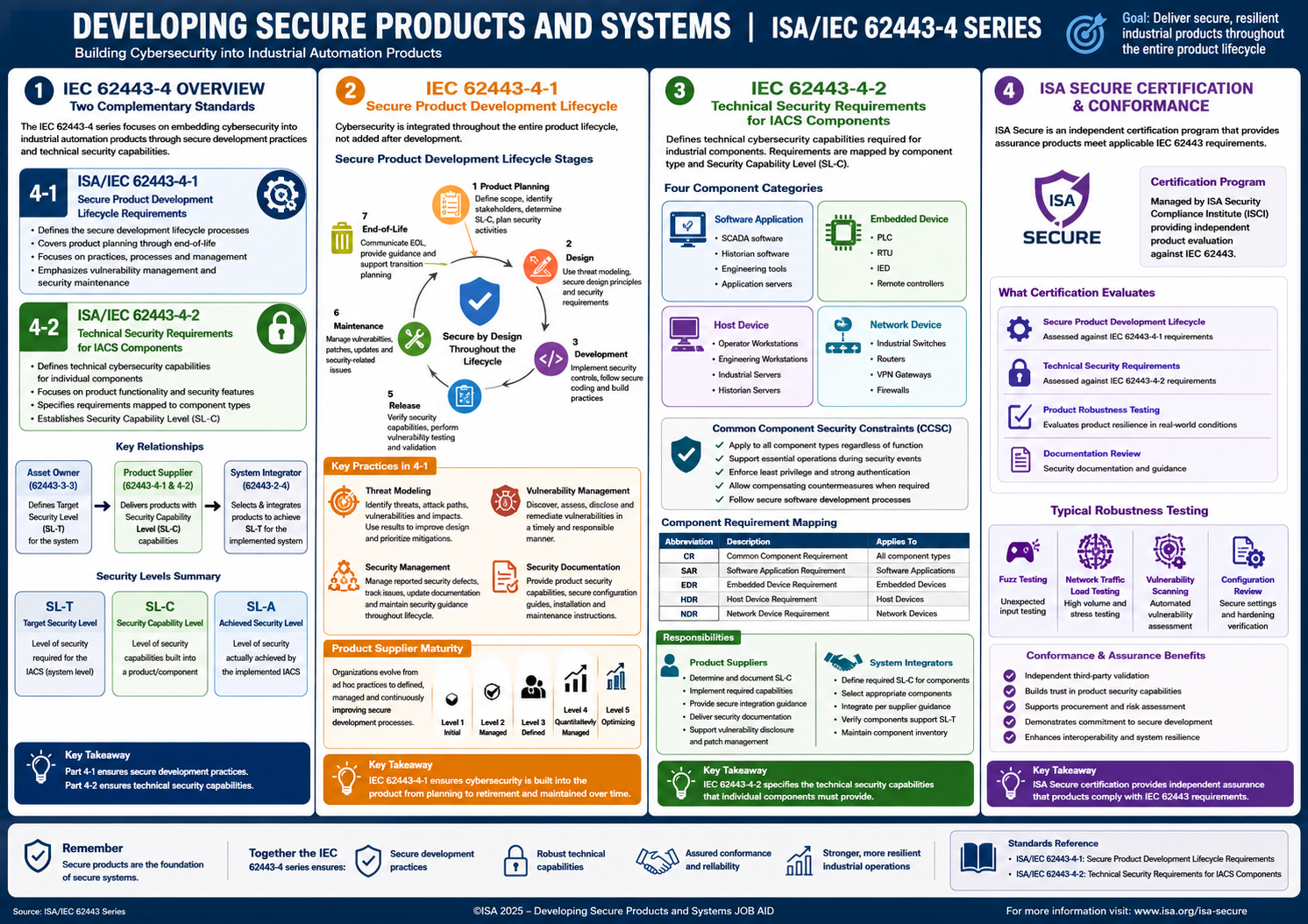
ISA/IEC 62443-4-1:2018 defines process requirements for a secure product development lifecycle used by Product Suppliers of IACS control systems and components. It answers how products should be designed, built, maintained and retired securely. Technical capabilities those products must offer are specified separately in Part 3-3 (systems) and Part 4-2 (components).
Product suppliers are the main audience. The primary goal is a framework for secure by design with a defence-in-depth approach across designing, building, maintaining and retiring products — so a claimed Security Capability Level (SL-C) is backed by implemented capabilities and known vulnerabilities that have been eliminated or mitigated.
Reference: ISA/IEC 62443-4-1:2018 — Secure product development lifecycle requirements
Related:
IEC 62443-4-2 Technical Requirements
|
IACS Cybersecurity Roles
|
Automation Solution Security Lifecycle
|
Security Levels (SL-T / SL-C / SL-A)
Primary goal — provide a product-development framework that addresses:
In teaching terms, SL-C work asks:
Secondary goal — align the development process with industrial-user needs:
Key concepts: threat modelling (impact analysis and resolution) and a defence-in-depth strategy as the philosophy of the secure product lifecycle.
Part 4-1 groups supplier work into eight practices. Security management surrounds the other practices; defence-in-depth layers through requirements, design, implementation, V&V testing and guidelines.
| Practice | Code | Clause | Focus | Page |
|---|---|---|---|---|
| 1 – Security management | SM | 5 | Plan, staff, scope and govern the SDL (13 requirements) | Clause 5 |
| 2 – Specification of security requirements | SR | 6 | Security context, threat model, testable requirements (5) | Clause 6 |
| 3 – Secure by design | SD | 7 | Secure design principles and defence-in-depth (4) | Clause 7 |
| 4 – Secure implementation | SI | 8 | Implementation review and secure coding (2) | Clause 8 |
| 5 – Security verification and validation testing | SVV | 9 | Requirements, threat, vulnerability and penetration testing (5) | Clause 9 |
| 6 – Management of security-related issues | DM | 10 | Receive, assess, fix and disclose issues (6) | Clause 10 |
| 7 – Security update management | SUM | 11 | Qualify, document and deliver security patches (5) | Clause 11 |
| 8 – Security guidelines | SG | 12 | User docs for harden, operate, accounts and disposal (7) | Clause 12 |
Security management also covers ongoing handling of security defects and documentation updates as products evolve. Detailed requirement summaries sit on each practice page (SPE-style).
How do we know a supplier is actually meeting practice requirements? Part 4-1 uses a maturity model based on CMMI-DEV, adapted into four ISA/IEC 62443-4-1 levels. An organisation may sit at different maturity for different requirements.
| ML | ISA/IEC 62443-4-1 name | Meaning (teaching summary) |
|---|---|---|
| 1 | Initial | Ad hoc / incompletely documented development — repeatability across projects is unreliable. |
| 2 | Managed | Written policies and procedures exist; people are trained — but not every process has yet been practised on real products. |
| 3 | Defined (Practiced) | Processes have been practised with evidence; performance is repeatable across the organisation. |
| 4 | Improving | Combines CMMI-DEV Levels 4 and 5 ideas: metrics drive effectiveness and continuous improvement. |
Annex B of Part 4-1 tabulates the requirements; Clause 5 onward defines each practice in detail. Applicable requirements still apply to a given product (see SM-5 scoping) even while maturity is rising over time.
Related: IEC 62443-2-1 Maturity Levels (related ML idea for asset-owner programmes — use each part’s own tables when scoring)
Part 4-1 is independent of any one plant. Suppliers create and support products; integrators and asset owners later fold those products into an Automation Solution at a site. Secure products plus security guidelines feed design, implementation, operations and maintenance at the facility.
The ISA Security Compliance Institute (ISCI) operates independent product certification programmes aligned to these parts, including:
Further information: ISASecure.org